
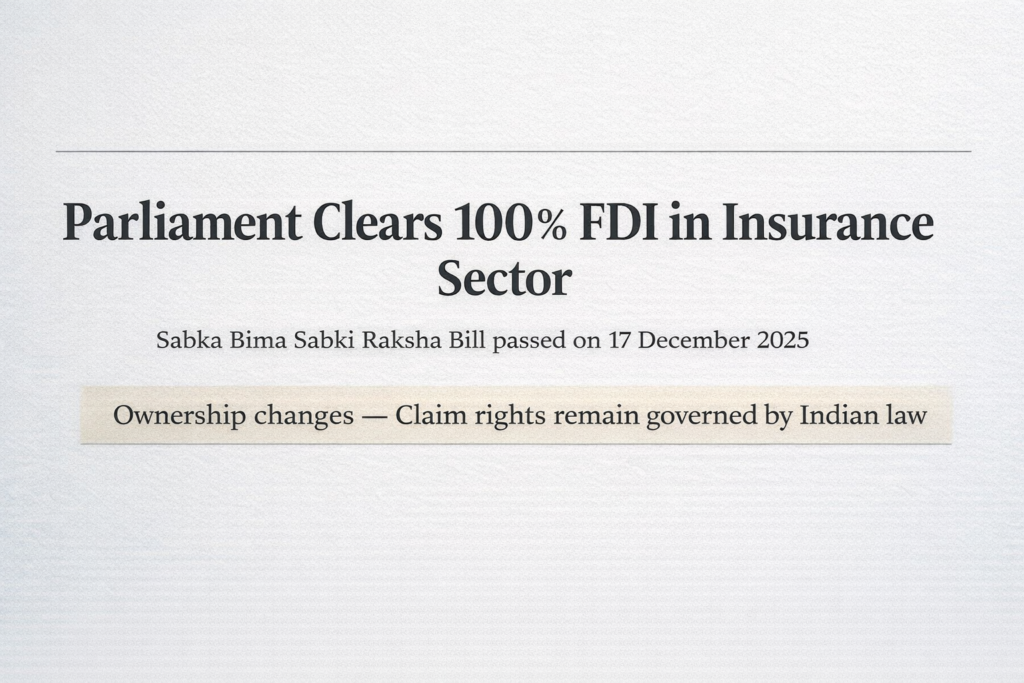

India’s Parliament has just passed a transformative piece of legislation that will reshape the insurance landscape for millions of policyholders and investors. On December 17, 2025, the Sabka Bima Sabki Raksha (Amendment of Insurance Laws) Bill, 2025, received parliamentary approval, marking a significant milestone in India’s financial liberalisation journey. This bill represents the government’s ambitious commitment to achieving “Insurance for All by 2047” and modernising the insurance sector through enhanced foreign investment and regulatory reforms.
What is the FDI Insurance Bill 2025?
The Insurance Amendment Bill 2025 is a comprehensive legislative package that amends three critical insurance-related laws: the Insurance Act 1938, the LIC Act 1956, and the IRDAI Act 1999. The bill introduces sweeping changes designed to attract global capital, improve competition, strengthen regulatory oversight, and ultimately expand insurance coverage across India.
Finance Minister Nirmala Sitharaman, while presenting the bill in Parliament, emphasised that these amendments are expected to strengthen job creation, skill development, and formal employment opportunities in the insurance sector and related industries. The legislation also focuses on creating a more robust framework for policyholder protection and institutional reforms.
The Game-Changer: 100% Foreign Direct Investment in Insurance
From 74% to 100% FDI Cap
The most headline-grabbing provision of the Insurance Amendment Bill 2025 is the increase in the Foreign Direct Investment (FDI) limit from 74% to 100% in Indian insurance companies. This monumental shift opens the doors for global insurers to establish wholly-owned subsidiaries in India without any equity restriction or government approval requirements beyond the standard regulatory framework.
Before this amendment, foreign investors seeking to invest more than 74% in an Indian insurance company had to obtain specific approval from the Indian government. This bureaucratic hurdle often delays investment decisions and creates uncertainty for potential investors. The new legislation eliminates this barrier, providing global insurers with unprecedented clarity and confidence to commit capital to India’s insurance market.
Why This Matters for India and the World
The decision to permit 100% FDI in insurance comes at a critical juncture when India’s insurance sector is vastly underpenetrated compared to global standards. According to the Economic Survey 2025, India’s overall insurance penetration stands at just 3.7% of GDP, significantly below the global average of 7%. Life insurance penetration is at 2.8%, while non-life insurance remains at a mere 1%.
This gap presents an enormous opportunity. Industry analysts project that India’s Gross Written Premiums (GWP) will grow by 123% by 2030, with insurance penetration expected to improve from 3.7% to 5%. The life insurance market alone is projected to reach $170 billion by 2029, growing at a compound annual growth rate of 9.6%.
Expected Benefits of 100% FDI
The increase in FDI limit is anticipated to deliver multiple benefits:
Enhanced Capital Inflows: Allowing full foreign ownership is expected to attract substantial and sustained capital investments from global insurance giants such as Prudential Plc, Sun Life Financial, AIG, and other international players. These capital infusions will strengthen the financial foundation of insurance companies and enable them to scale operations rapidly.
Technology Transfer and Innovation: Foreign insurers typically bring cutting-edge technology, sophisticated underwriting models, advanced risk assessment frameworks, and innovative product development capabilities. These technological advancements will significantly improve operational efficiency, customer service, and claims processing speed in the Indian insurance market.
Competitive Intensity: The entry of well-capitalised global players will intensify competition in India’s insurance market. This competition is expected to benefit consumers through better pricing, wider product variety, and improved service quality.
Better Products for Consumers: Global insurers will introduce insurance products tailored to the Indian market’s needs, combining global expertise with local insights. Consumers can expect access to more customised policies, better coverage options, and more competitive premium rates.
Employment and Skill Development: The expansion of insurance operations is expected to create employment opportunities and drive skill development across sectors. The financial services and professional services industries will see increased demand for skilled professionals in insurance, legal compliance, actuarial science, and technology roles.
Other Key Provisions of the Insurance Amendment Bill 2025
Beyond the landmark 100% FDI provision, the bill introduces several other important reforms:
Enhanced Powers for the Insurance Regulatory and Development Authority of India (IRDAI)
The IRDAI, India’s primary insurance regulator, has been granted significantly strengthened enforcement powers and regulatory tools:
Disgorgement Powers: The IRDAI now has the authority to recover any wrongful or unlawful gains made by insurance companies in violation of regulations. This is a powerful enforcement mechanism similar to those available to the Securities and Exchange Board of India (SEBI), India’s financial market regulator.
Streamlined Intermediary Registration: The bill introduces a one-time registration system for insurance intermediaries (agents, brokers, and other representatives), reducing compliance burden and making market entry easier for legitimate intermediaries.
Raised Equity Transfer Threshold: The threshold for IRDAI approval of equity transfers in insurance companies has been increased from 1% to 5%. This change grants greater operational autonomy to insurance companies and reduces regulatory delays in business restructuring and ownership transfers.
Regulatory Transparency and Predictability: The bill mandates that IRDAI establish clear Standard Operating Procedures (SOPs) for regulation-making and penalty determination. This regulatory clarity improves investor confidence and ensures consistent and transparent rule application.
Enhanced Commission Oversight: The IRDAI is now empowered to set limits on commissions paid to insurance agents and intermediaries through legislative authority, rather than relying on executive powers. This ensures a more stable and predictable commission framework.
Liberalisation for Foreign Reinsurance Players
The bill significantly eases entry barriers for foreign reinsurers operating in India:
Reduced Capital Requirements: The Net Owned Funds (NOF) requirement for foreign reinsurers has been reduced from ₹5,000 crore to ₹1,000 crore. Net Owned Funds comprise paid-up equity capital, free reserves, balance in share premium accounts, and capital reserves.
This reduction is particularly significant because it addresses a longstanding industry demand to increase competition in India’s reinsurance market beyond the public sector player, General Insurance Corporation Re (GIC Re). The lower capital requirement will encourage more foreign reinsurance companies to establish operations in India.
Benefits of Increased Reinsurance Competition: Better competition in the reinsurance market is expected to improve risk diversification, increase capacity for large and catastrophic risks, and enhance pricing efficiency across the entire insurance sector. This benefits both primary insurers and, ultimately, policyholders.
Greater Operational Autonomy for Life Insurance Corporation (LIC)
The bill grants enhanced operational and governance flexibility to the Life Insurance Corporation of India, facilitating its growth as a global-scale insurer. These reforms support LIC’s competitive positioning against foreign competitors and enable better strategic decision-making.
Merger and Consolidation Framework
The bill permits insurance companies to merge with non-insurance firms, provided the combined entity remains primarily in the insurance business. This creates opportunities for insurance companies to diversify into adjacent financial services and for fintech companies to acquire insurance operations.
Policyholder Protection Fund
The legislation enables the creation of a dedicated fund specifically for policyholder education and protection. This mechanism strengthens the consumer protection framework and ensures that policyholders have resources for grievance resolution and financial protection.
What the Bill Does NOT Include
It’s equally important to understand what provisions were excluded or diluted in the final bill, as these omissions are generating discussion among industry stakeholders:
No Composite License Provision: The bill does not include the earlier proposed “composite license” framework that would have allowed a single insurance company to offer life insurance, general insurance, and health insurance under one entity. In India’s current regulatory structure, life insurers cannot sell health or general insurance, while general insurers are restricted to non-life products. This structural separation remains intact, which some industry players view as a limitation on business expansion opportunities.
Capital Requirements Unchanged: The minimum capital requirements for new insurance entrants remain unchanged at ₹100 crore for insurers and ₹200 crore for reinsurers. This high barrier to entry continues to deter small, niche, regional, and specialised insurers. Many industry experts argue that lower capital requirements could have significantly expanded insurance penetration in rural areas and among underserved populations such as gig workers, micro-enterprises, and low-income households.
Captive Insurance Sector: The bill does not address the liberalisation of captive insurance (where large companies self-insure), which some industry players had advocated for.
The Current State of India’s Insurance Sector: Key Statistics
Understanding the context makes the importance of these reforms even clearer:
Market Size and Growth
Premium Collections: India’s insurance sector collected total premiums of ₹11.2 lakh crore in FY 2024, representing 7.7% year-over-year growth compared to ₹10.4 lakh crore in FY 2023.
Life Insurance: Life insurers collected premiums of ₹8.3 lakh crore in FY 2024, up from ₹7.8 lakh crore in FY 2023, marking a 6.1% increase.
Non-Life Insurance: Non-life insurers collected gross direct premiums of ₹2.9 lakh crore in FY 2024, up from ₹2.6 lakh crore in FY 2023, representing 7.7% growth. Health and motor segments led this growth.
Insurance Penetration and Density
Penetration Gap: Insurance penetration in India remains at just 3.7% of GDP, down from 4% in the previous year. This is significantly below the global average of 7%, indicating vast untapped potential.
Segment-Wise Penetration:
- Life Insurance: 2.8% of GDP (down from 3% previously)
- Non-Life Insurance: 1% of GDP (unchanged)
Insurance Density: The average insurance expenditure per capita, known as insurance density, showed modest improvement at $95 in FY 2024, up from $92 in FY 2023. However, India’s insurance density remains low compared to developed markets.
Foreign Investment in Indian Insurance
The potential of 100% FDI is underscored by the fact that significant capital has already flowed into the insurance sector under the 74% cap. As of now, ₹27,000 crore in FDI has been received since the limit was raised to 74% in 2021. Currently, four Indian insurance companies operate with 74% FDI.
Current Insurance Landscape
India currently has 74 active insurance companies, including those with foreign investment partnerships such as joint ventures with Prudential Plc, Sun Life Financial, AIG, and other international insurers. The competitive landscape includes both public sector players (like LIC and public sector general insurers) and private insurers, both domestic and foreign-backed.
The Critical Issue: Insurance Claim Rejections and the Need for Legal Support
While the FDI reforms are positive for sector growth, one pressing challenge that requires urgent attention is the rising tide of insurance claim rejections in India. Understanding this issue is crucial for BookMyVakil’s role in supporting policyholders:
Alarming Statistics on Claim Rejections
Record Rejections: Insurance companies disallowed and repudiated health insurance claims worth a staggering ₹26,000 crore during FY 2024, marking a 19% increase from the ₹21,861 crore rejected in the previous year.
Categories of Rejection:
- Claims Disallowed: ₹15,100 crore (up from ₹12,754 crore previously) – these are claims rejected outright due to documentation errors, procedure violations, or policy term issues before full evaluation.
- Claims Repudiated: ₹10,937 crore (up from ₹9,107 crore) – these are claims denied after full review and assessment, when the insurer determines non-compliance with policy terms.
Percentage of Rejections: Approximately 11% of all health insurance claims filed in India are denied or repudiated. An additional 6% remain stuck in limbo, pending settlement. This means that roughly one in ten policyholders who file health insurance claims face outright rejection.
Why Claims Are Being Rejected
Insurance companies cite several reasons for rejections:
- Non-disclosure of pre-existing medical conditions
- Documentation gaps and incomplete information
- Policy terms violations
- Hospitalisation deemed “unnecessary” by insurers
- Procedural errors in claim filing
- Fraudulent claims (a small percentage)
The Policyholder’s Dilemma
For many policyholders, claim rejection is financially devastating. After paying premiums for years, when they need insurance protection most—during medical emergencies or health crises—their claims are denied or delayed. This creates a crisis of confidence in India’s insurance system.
Standalone health insurers show particularly low claim settlement ratios, with some settling only 64.71% of claims. This compares unfavorably to public sector insurers, which maintain a 103.38% claim settlement ratio (meaning they pay more than they collect in premiums for certain categories, indicating good claims handling).
The Role of Legal Advocates in Claim Dispute Resolution
This is where platforms like BookMyVakil play a critical role. As claim rejections increase, policyholders need expert legal guidance to:
- Challenge Claim Rejections: Legal advocates can analyse policy terms, review insurer decisions, and build compelling cases for claim reversal.
- Navigate Regulatory Channels: The Insurance Ombudsman, established by IRDAI, provides a dispute resolution mechanism for claims up to ₹5 million. Legal professionals help policyholders file complaints effectively.
- Pursue Consumer Court Remedies: Under the Consumer Protection Act 2019, insurance disputes can be escalated to consumer courts at the district, state, and national levels based on claim value and premium amount.
- Implement Alternative Dispute Resolution: Arbitration and mediation offer faster, more cost-effective alternatives to litigation for insurance disputes.
- Ensure Compliance: Legal advocates ensure that all filing deadlines, documentation requirements, and procedural steps are meticulously followed.
How the FDI Reforms Will Impact Insurance Claim Resolution
The 100% FDI reform and enhanced IRDAI powers will have significant implications for claim resolution:
Potential Improvements
Enhanced Regulatory Oversight: The IRDAI’s strengthened enforcement powers mean stricter regulation of claim settlement practices. Insurance companies will face increased scrutiny and penalties for improper claim denials.
Adoption of Global Standards: Foreign insurers typically bring advanced claims processing systems and higher service standards. Global competition will likely pressure all insurers to reduce claim rejection rates and improve settlement ratios.
Technology-Driven Resolution: Foreign insurers often deploy artificial intelligence and automation for claims assessment, potentially reducing human error and claim processing delays.
Consumer Protection Focus: With increased competition, insurers will be incentivised to improve customer service and claims handling to maintain market share and customer loyalty.
Increased Demand for Legal Services
As insurance operations expand and competition intensifies, the volume of claim disputes may initially increase. This represents a significant growth opportunity for specialised legal services firms like BookMyVakil that focus on insurance claim resolution and policyholder advocacy.
Foreign insurers entering the Indian market will also need extensive legal support for regulatory compliance, policy documentation, and dispute resolution. This creates B2B opportunities for legal advisory services.
Implications for Different Stakeholders
For Policyholders
Policyholders stand to benefit significantly from these reforms:
- Better Products: Access to more innovative insurance products at competitive rates
- Improved Service: Competition will drive service quality improvements
- More Options: Greater variety in insurance products and providers
- Regulatory Protection: Enhanced IRDAI oversight ensures stricter compliance
However, policyholders should remain vigilant about reading policy documents carefully, disclosing all material information truthfully, and seeking legal help when claims are denied.
For Insurance Companies
Both existing insurers and new entrants will face a more competitive environment:
- Incumbent Advantages: Established insurers can leverage their distribution networks and brand recognition
- New Opportunities: Foreign insurers can now establish wholly-owned subsidiaries and capture market share
- Capital Availability: Access to global capital markets and parent company financing
- Pressure on Margins: Increased competition will compress profit margins unless companies differentiate through service or innovation
For Investors
Investors will find India’s insurance sector increasingly attractive:
- Clarity on Ownership: 100% FDI removes investment restrictions
- Growing Market: Low insurance penetration means substantial growth potential
- Regulatory Framework: IRDAI provides transparent, internationally-aligned regulation
- Demographic Dividend: India’s young population and rising incomes support insurance demand
For the Indian Economy
The insurance sector reforms will contribute to broader economic objectives:
- Financial Inclusion: Expanded insurance coverage strengthens financial security for millions
- Capital Formation: Insurance premium collections feed into long-term investment pools
- Employment: Expansion creates jobs across insurance, technology, and professional services
- Macroeconomic Stability: Better insurance penetration reduces financial vulnerability to shocks
The Legal Framework Surrounding Insurance Disputes in India
Understanding the regulatory and legal framework is essential for anyone navigating insurance disputes:
Primary Regulators and Authorities
Insurance Regulatory and Development Authority of India (IRDAI): The apex regulator responsible for licensing, regulation, and supervision of insurance companies and intermediaries. IRDAI’s Protection of Policyholders’ Interests (PPHI) Master Circular (issued September 5, 2024) establishes timelines and procedures for claim handling and grievance resolution.
Key Requirement: Insurers must resolve complaints and issue final resolution letters within 14 days of acknowledgement. Failure to meet this timeline results in penalties of ₹5,000 per day.
Dispute Resolution Mechanisms
Insurance Ombudsman: An independent officer appointed to resolve complaints between policyholders and insurers. Key features include:
- Jurisdiction for claims up to ₹5 million (recently increased)
- Free service for policyholders
- Faster resolution compared to courts
- Multiple ombudsman offices across India
Consumer Courts: Under the Consumer Protection Act 2019, insurance disputes can be escalated to consumer commissions at three levels:
- District Consumer Commission: Claims up to ₹1 crore
- State Consumer Commission: Claims between ₹1 crore and ₹10 crore
- National Consumer Commission: Claims exceeding ₹10 crore
Commercial Courts: For disputes exceeding certain monetary thresholds, commercial courts provide specialised forums for insurance litigation.
Arbitration: Many insurance policies include arbitration clauses, allowing disputes to be resolved through private arbitrators, often faster and more confidentially than court litigation.
Consumer Protection Rights
Insurance policyholders are treated as consumers under the law and enjoy comprehensive protection:
- Right to information about policy terms and conditions
- Right to file complaints with the insurer’s grievance redressal department
- Right to escalate complaints to the Insurance Ombudsman
- Right to approach consumer courts
- Right to seek compensation for wrongful claim denials
- Right to legal representation
What’s Next: Implementation Timeline and Market Expectations
Immediate Impact
The bill received parliamentary approval on December 17, 2025, and is expected to be notified and become operational in the coming weeks. Insurance companies and potential foreign investors are already preparing for implementation.
Expected Foreign Investor Response
Global insurance players are closely monitoring the situation. Large multinational insurers from the United States, the United Kingdom, Europe, and the Asia-Pacific are likely to evaluate opportunities for wholly-owned subsidiaries or significant stake acquisitions in Indian insurance companies.
Industry experts expect foreign insurers to initially focus on:
- High-premium customer segments
- Urban markets with higher insurance awareness
- Specialised products (cyber insurance, product liability, etc.)
- Digital-first distribution models
- Technology-enabled claims processing
Regulatory Implementation
The IRDAI is expected to issue detailed regulations and guidelines for 100% FDI implementation, addressing:
- Ownership transfer and acquisition procedures
- Governance requirements for foreign-owned subsidiaries
- Regulatory reporting and compliance standards
- Protection of policyholders’ interests
- Anti-money laundering and know-your-customer (KYC) requirements
Market Growth Projections
With 100% FDI approved, market analysts project:
- Increase in total insurance premium collections from current ₹11.2 lakh crore to potentially ₹20+ lakh crore by 2030
- Expansion of insurance density from $95 to $150+
- Growth in insurance penetration from 3.7% to 5-6% of GDP
- Job creation of 500,000+ employment opportunities
- Entry of 10-15 new foreign-backed insurance entities
Recommendations for Different Stakeholders
For Policyholders
- Understand Your Policy: Read policy documents thoroughly before purchase. Understand coverage, exclusions, and claim procedures.
- Disclose Truthfully: Provide accurate and complete information during underwriting. Non-disclosure of material facts can lead to claim rejection.
- Maintain Documentation: Keep all medical records, receipts, prescriptions, and other relevant documentation organised and easily accessible.
- Know Your Rights: Understand the insurance grievance redressal mechanism, Insurance Ombudsman procedures, and consumer court options.
- Seek Legal Help Early: If a claim is rejected or significantly delayed, consult a legal professional immediately. Don’t assume insurers’ decisions are final.
- Consider Professional Assistance: For complex claims (major health issues, large claim amounts), engaging a legal advocate can significantly improve your chances of success.
For Insurance Companies (Both Domestic and Foreign)
- Strengthen Compliance: Implement robust systems to ensure adherence to IRDAI regulations and claim settlement timelines.
- Invest in Technology: Deploy AI-powered claims assessment systems to reduce errors and speed up processing.
- Enhance Transparency: Communicate clearly with policyholders about claim decisions, providing detailed reasons for any denials.
- Build Reputation: In a competitive market, handling claims ethically and promptly becomes a key differentiator.
- Regulatory Engagement: Maintain active dialogue with IRDAI to understand evolving regulatory expectations.
For Legal Professionals and Service Providers
- Develop Expertise: Insurance law is becoming an increasingly important practice area. Develop deep expertise in IRDAI regulations, insurance policy interpretation, and claim dispute procedures.
- Leverage Technology: Build digital platforms (like BookMyVakil) to make insurance legal services more accessible and affordable.
- Focus on Alternative Dispute Resolution: Ombudsman complaints and arbitration often provide faster, more cost-effective solutions than litigation.
- Expand Service Offerings: As insurance penetration grows, develop complementary services like policy review, claims documentation assistance, and regulatory compliance guidance.
- Build Partnerships: Collaborate with insurance brokers, consumer advocacy groups, and fintech companies to create integrated solutions.
For Investors and Entrepreneurs
- Identify Growth Opportunities: The expanding insurance market, combined with low digital penetration, creates opportunities for insurtech startups.
- Address Market Gaps: Focus on underserved segments—rural areas, informal sector workers, low-income households—where insurance penetration is minimal.
- Leverage Global Partnerships: Consider partnering with foreign insurers entering India to offer complementary services.
- Regulatory Alignment: Ensure all business models comply with IRDAI regulations and evolving foreign investment rules.
The Future of Insurance in India: Vision 2047
The 100% FDI Insurance Amendment Bill 2025 is a crucial step toward the government’s ambitious vision of “Insurance for All by 2047.” This long-term vision encompasses:
- Universal Coverage: Every Indian family has access to appropriate insurance protection
- Financial Inclusion: Insurance reaches traditionally underserved populations—rural residents, informal workers, marginalised communities
- Innovation: New insurance products address evolving needs—cyber insurance, climate risk insurance, gig economy coverage
- Digital Accessibility: Insurance services are easily accessible through digital platforms
- Consumer Protection: Robust regulatory frameworks ensure policyholder interests are protected
- Economic Growth: Insurance sector becomes a significant contributor to India’s GDP, capital formation, and employment
Achieving this vision requires sustained effort from government, regulators, insurance companies, technology partners, and legal professionals. The FDI reforms represent a fundamental shift toward this goal.
Conclusion: A Transformative Moment for Indian Insurance
The passage of the Insurance Amendment Bill 2025 on December 17, 2025, marks a transformative moment for India’s insurance sector. By opening the doors to 100% foreign direct investment, strengthening regulatory oversight, facilitating capital flows, and creating a more competitive environment, the bill sets the stage for rapid sector growth and modernisation.
For policyholders, these reforms promise better products, more competitive pricing, and improved service quality. For investors and companies, they present unprecedented opportunities in a vast, underpenetrated market. For legal professionals and service providers, they signal growing demand for specialised expertise in insurance law, claims resolution, and regulatory compliance.
However, the reforms also highlight the continuing need for robust policyholder protection mechanisms. With claim rejections reaching ₹26,000 crore annually and 11% of health claims being denied, there’s a critical role for legal advocates and specialised platforms to help policyholders navigate the insurance system and protect their interests.
As India’s insurance sector enters a new era of liberalisation and competition, the synergy between regulatory reform, technological innovation, and expert legal support will determine whether the promise of “Insurance for All by 2047” becomes a reality. For platforms like BookMyVakil, this represents both an opportunity and a responsibility to serve policyholders who need expert guidance navigating an increasingly complex insurance landscape.
Key Takeaways
✓ 100% FDI in insurance approved – Foreign investors can now fully own Indian insurance companies
✓ Enhanced IRDAI powers – Stronger regulatory oversight and enforcement mechanisms
✓ Lower barriers for foreign reinsurers – NOF requirement reduced from ₹5,000 crore to ₹1,000 crore
✓ Insurance penetration opportunity – India’s 3.7% penetration vs 7% global average
✓ Growing claim disputes – ₹26,000 crore in annual claim rejections require legal support
✓ Legal services in demand – Expert advocacy critical for policyholders navigating claim rejections
✓ Market growth expected – 123% GWP growth projected by 2030
✓ Investment clarity improved – Clear regulatory framework attracts global capital
For policyholders facing insurance claim rejections, denied claims, or policy disputes, BookMyVakil offers expert legal advocacy to help resolve insurance matters through ombudsman complaints, consumer courts, and alternative dispute resolution mechanisms. Contact us today for a free consultation on your insurance issue.
